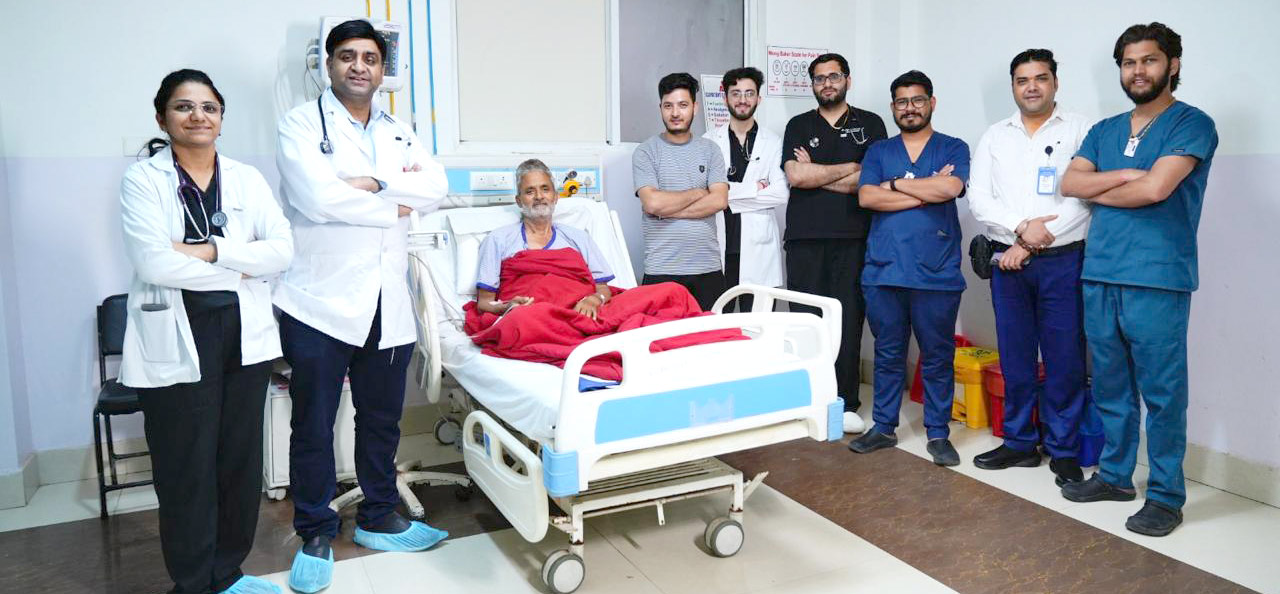
A heart patient gets a new lease on life without undergoing open-heart surgery through TAVI technology
The Department of Cardiology at Shri Mahant Indiresh Hospital has achieved a significant milestone in the medical field by successfully treating a highly complex and high-risk heart patient using the advanced TAVI (Transcatheter Aortic Valve Implantation) technique.
The 59-year-old male patient was suffering from severe calcific aortic stenosis along with multiple valve complications. An earlier attempt at open-heart surgery had to be abandoned midway due to a critical condition known as “porcelain aorta.” In such cases, excessive calcification in the aortic wall makes it extremely risky to clamp or intervene in the aorta during surgery, significantly increasing the risk of stroke and other complications.
Considering the patient’s critical condition, he was categorized under “surgical turndown,” where conventional surgery was not feasible, and TAVI remained the only safe and life-saving option.
Under the leadership of Prof. Dr. Tanuj Bhatia, Head of the Cardiology Department at Shri Mahant Indiresh Hospital, an experienced multidisciplinary team successfully carried out this challenging procedure. The team included Dr. Ashok Jayant (CTVS Cardiac Surgeon), Dr. Hari Om Khandelwal (Senior Cardiac Anaesthetist), along with Dr. Jaykrit Chaudhary, Dr. Manik, Dr. Parag, and Dr. Vasu.
The complex procedure utilized advanced imaging techniques, precision-guided intervention, and state-of-the-art equipment, enabling the safe implantation of a new aortic valve without opening the chest.
TAVI is considered a revolutionary treatment in modern cardiology, as it eliminates the need for major open-heart surgery. In this procedure, a catheter is used to reach the heart through blood vessels and replace the damaged valve with a new one. This approach not only reduces surgical risks but also ensures less pain, faster recovery, and an early return to normal life for the patient.
According to Dr. Tanuj Bhatia, the successful treatment of such complex cases requires not only modern infrastructure but also a high level of clinical expertise, teamwork, and strong coordination among various departments. This achievement highlights not only the hospital’s advanced medical capabilities but also the growing capacity for treating structural heart diseases in the region.